field hockey at the summer olympics standings
Introduction: Field Hockey at the Summer Olympics Standings
Field hockey is one of the oldest team sports in the Olympic programme, and its standings tell a story of changing powers. India dominated the early decades, Pakistan and Germany took over, Australia and the Netherlands built long dynasties, and in recent years Belgium and Argentina have joined the elite. This guide covers the field hockey at the Summer Olympics standings in full: the latest Paris 2024 results, all-time gold medal tables for men and women, recent podiums, the tournament format, and what to expect at Los Angeles 2028.
Table of Contents
Field Hockey at the Summer Olympics: A Quick Overview
Field hockey has appeared at the Summer Games since London 1908, and the men’s tournament has been held at almost every Games since. The women’s tournament joined in 1980. Both events now feature 12 teams.
Key Facts at a Glance
| Detail | Men | Women |
|---|---|---|
| First Olympic appearance | 1908 (London) | 1980 (Moscow) |
| Teams in the tournament | 12 | 12 |
| Most recent Games | Paris 2024 | Paris 2024 |
| Reigning Olympic champion | Netherlands | Netherlands |
| Most Olympic gold medals | India (8) | Netherlands (5) |
| Next Olympics | Los Angeles 2028 | Los Angeles 2028 |
Is There a Current “Standings” Table?
Olympic hockey is played only once every four years, so there are no live standings between Games. When people search for “standings,” they usually want one of four things:
- The final ranking from the latest Games (Paris 2024)
- The pool-stage tables from a specific tournament
- The all-time medal table
- The qualification standings leading to the next Olympics
This article covers all four.
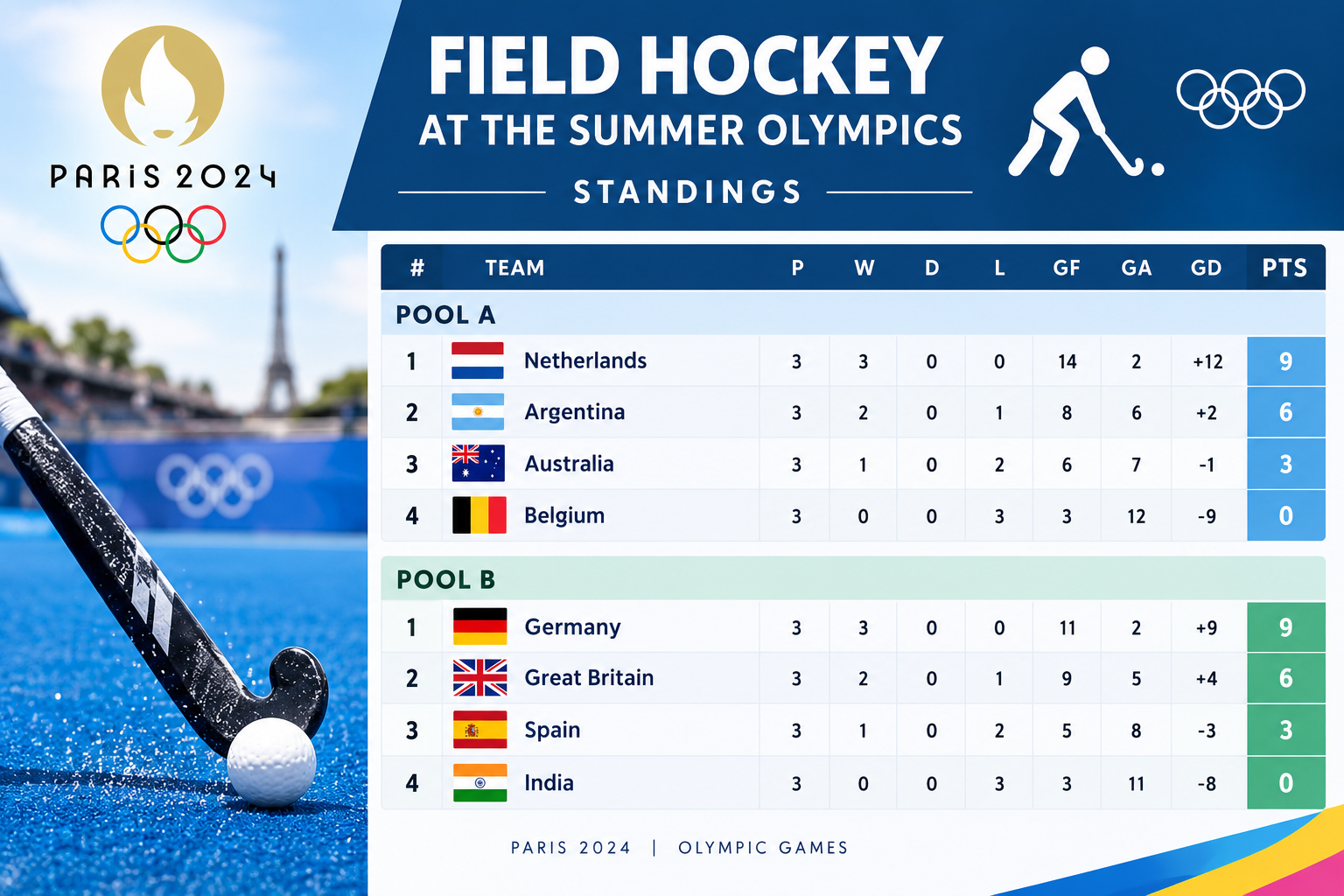
Paris 2024 Field Hockey Final Standings
The Paris 2024 tournament was played at the Yves-du-Manoir Stadium in Colombes, near Paris. Both finals ended level after regulation time and were decided by penalty shootouts.
Paris 2024 Medal Winners
| Rank | Men’s Tournament | Women’s Tournament |
|---|---|---|
| 🥇 Gold | Netherlands | Netherlands |
| 🥈 Silver | Germany | China |
| 🥉 Bronze | India | Argentina |
Men’s Tournament Summary
The Netherlands and Germany met in the final and drew 1-1 in regulation. The Dutch won the shootout to take gold, their third men’s Olympic title after 1996 and 2000.
India’s route to bronze was dramatic:
- In the quarterfinal against Great Britain, India played much of the match with ten men after a red card, drew 1-1 and won the shootout.
- In the semifinal, India lost 3-2 to Germany.
- In the bronze medal match, India beat Spain 2-1, with captain Harmanpreet Singh scoring both goals.
The bronze was India’s second in a row. It was also the last match for goalkeeper P. R. Sreejesh, who retired after the Games.
Women’s Tournament Summary
The Dutch women were again the team to beat. The final against China finished 1-1, and the Netherlands won the shootout to claim their fifth Olympic gold. China’s silver was the best result in its Olympic hockey history in the women’s event since its earlier silver at Beijing 2008. Argentina took bronze, continuing a long record of Olympic podium finishes.
How the Paris Standings Were Decided
| Stage | What Happened |
|---|---|
| Pool stage | 12 teams split into two pools of six; each team played five matches |
| Pool ranking | 3 points for a win, 1 for a draw, 0 for a loss |
| Quarterfinals | Top four teams from each pool advanced |
| Semifinals | Four quarterfinal winners played for a place in the final |
| Medal matches | Gold final and bronze medal match |
| Draws in knockout games | Settled by penalty shootout |
All-Time Olympic Field Hockey Medal Standings
Because there is no single combined table for every era, the most useful measure is the number of gold medals won. Below are the all-time gold totals through Paris 2024.
Men’s Olympic Gold Medals by Nation
| Rank | Nation | Gold Medal Years | Golds |
|---|---|---|---|
| 1 | India | 1928, 1932, 1936, 1948, 1952, 1956, 1964, 1980 | 8 |
| 2 | Germany (incl. West Germany) | 1972, 1992, 2008, 2012 | 4 |
| 3 | Great Britain | 1908, 1920, 1988 | 3 |
| 3 | Netherlands | 1996, 2000, 2024 | 3 |
| 3 | Pakistan | 1960, 1968, 1984 | 3 |
| 6 | Australia | 2004 | 1 |
| 6 | Argentina | 2016 | 1 |
| 6 | Belgium | 2020 (Tokyo) | 1 |
| 6 | New Zealand | 1976 | 1 |
Women’s Olympic Gold Medals by Nation
| Rank | Nation | Gold Medal Years | Golds |
|---|---|---|---|
| 1 | Netherlands | 1984, 2008, 2012, 2020, 2024 | 5 |
| 2 | Australia | 1988, 1996, 2000 | 3 |
| 3 | Germany | 2004 | 1 |
| 3 | Great Britain | 2016 | 1 |
| 3 | Spain | 1992 | 1 |
| 3 | Zimbabwe | 1980 | 1 |
What These Tables Show
The men’s table reveals three distinct eras. India’s eight golds came mostly between 1928 and 1956, a stretch often called the golden age of Indian hockey. Pakistan and Germany then took turns at the top. In the modern era, the sport has become more open, with Belgium and Argentina winning titles that once seemed out of reach.
The women’s table is a story of Dutch dominance. The Netherlands has won five of the twelve women’s Olympic tournaments, and Australia’s three golds came in a remarkable run through the late 1980s and 1990s.
Recent Olympic Podiums: 2008 to 2024
Looking at the last five Games shows how the standings have shifted.
Men’s Podiums
| Year | Host City | Gold | Silver | Bronze |
|---|---|---|---|---|
| 2008 | Beijing | Germany | Spain | Australia |
| 2012 | London | Germany | Netherlands | Australia |
| 2016 | Rio de Janeiro | Argentina | Belgium | Germany |
| 2020 | Tokyo | Belgium | Australia | India |
| 2024 | Paris | Netherlands | Germany | India |
Women’s Podiums
| Year | Host City | Gold | Silver | Bronze |
|---|---|---|---|---|
| 2008 | Beijing | Netherlands | China | Argentina |
| 2012 | London | Netherlands | Argentina | Great Britain |
| 2016 | Rio de Janeiro | Great Britain | Netherlands | Germany |
| 2020 | Tokyo | Netherlands | Argentina | Great Britain |
| 2024 | Paris | Netherlands | China | Argentina |
Trends Worth Noting
Men. The Rio and Tokyo Games produced two first-time Olympic champions in Argentina and Belgium. Germany remains the most consistent medal contender over the long run, and India has returned to the podium after a 41-year gap that ended in Tokyo.
Women. The Netherlands has won four of the last five Olympic titles. The one exception was Rio 2016, when Great Britain beat the Dutch in a shootout in the final. Argentina has been a regular medallist and remains one of the most competitive sides in the world.
India’s Olympic Hockey Record
No discussion of the standings is complete without India. The men’s team has won more Olympic hockey medals than any other nation.
India’s Olympic Hockey Medals
| Medal | Years | Count |
|---|---|---|
| Gold | 1928, 1932, 1936, 1948, 1952, 1956, 1964, 1980 | 8 |
| Silver | 1960 | 1 |
| Bronze | 1968, 1972, 2020, 2024 | 4 |
| Total | 13 |
Why India’s Record Matters
Between 1928 and 1956, India won six consecutive Olympic gold medals. The 1980 gold in Moscow came at a Games affected by a boycott, so the field was thinner, but it remains part of the record. After decades without a medal, the bronzes in Tokyo and Paris signalled a genuine revival, driven by a young squad, strong goalkeeping and effective penalty corner play.
How the Olympic Hockey Tournament Works
Understanding the format makes the standings easier to read.
Pool Stage Format
The 12 teams in each tournament are divided into two pools of six. Every team plays the other five in its pool. A win earns 3 points, a draw earns 1 and a loss earns nothing. Teams are ranked by points, with tiebreakers based on the number of wins, goal difference and goals scored.
Knockout Stage
The top four teams in each pool advance to the quarterfinals. From there it is straight knockout: quarterfinals, semifinals, then the final and the bronze medal match. If a knockout match is level after four quarters, it goes to a penalty shootout.
Modern Rule Changes
| Rule or Feature | Detail |
|---|---|
| Match structure | Four quarters of 15 minutes (introduced in 2019) |
| Green card | Two-minute suspension for a player |
| Yellow card | Five or ten-minute suspension |
| Red card | Permanent removal; the team plays a player short |
| Video umpire | Teams can request a review of certain decisions |
| Shootout | Five attempts per side, each taken within a time limit |
The move to four quarters made the game faster and added a short break between each period. Together with video reviews, it has shaped how coaches manage possession and defend penalty corners.
Historical Milestones in Olympic Field Hockey
From Grass to Artificial Turf
Early Olympic hockey was played on grass. Artificial turf was introduced at Montreal 1976, and it changed the sport. Asian teams such as India and Pakistan had thrived on natural grass, where stick skills mattered most. The faster synthetic surface favoured European and Australian sides with more access to turf facilities, which helped drive the shift in power.
The Arrival of Women’s Hockey
Women’s field hockey entered the Olympics in 1980. Zimbabwe won that first tournament, partly because several leading nations stayed away. Since then, the Netherlands and Australia have been the standard-setters, with Argentina and Germany close behind.
Notable Records
| Record | Detail |
|---|---|
| Most men’s Olympic golds | India, 8 |
| Most women’s Olympic golds | Netherlands, 5 |
| Six straight men’s golds | India, 1928 to 1956 |
| First women’s champion | Zimbabwe, 1980 |
| First-time men’s champions in the 2010s and 2020s | Argentina (2016) and Belgium (2020) |
Nations to Watch: The Contenders
Men’s Contenders
Netherlands. The reigning champions combine an attacking style with depth in every position. They are the standard to beat heading into the next cycle.
Germany. Perennial finalists, Germany reached the Paris final and has medalled at most recent Games.
Belgium. The Red Lions have been among the best teams in the world for a decade and are always strong at the Olympics.
India. With a settled core of players and a proven penalty corner routine, India enters each Games as a genuine medal threat.
Australia. The Kookaburras have a rich Olympic history and are consistently in contention.
Argentina and Spain. Both are physical, organised sides capable of beating anyone on their day.
Women’s Contenders
Netherlands. Overwhelming favourites in nearly every tournament.
Argentina. Los Leonas have medalled repeatedly and combine flair with discipline.
China, Germany, Belgium and Great Britain. All can reach the latter stages, and China’s run to the Paris final showed how quickly a team can rise.
Qualification and the Road to Los Angeles 2028
How Teams Qualify
Each Olympic hockey tournament has 12 places per gender. Spots are typically filled in three ways:
| Route | Description |
|---|---|
| Host nation | The host country receives an automatic place |
| Continental champions | Winners of the major continental championships earn a spot |
| FIH qualification events | Remaining spots are decided through qualifying tournaments or rankings |
The exact pathway for Los Angeles 2028 is set by the International Hockey Federation (FIH), so check its official website for the latest qualification rules and dates, as these can change.
What to Expect in 2028
Hockey is on the programme for Los Angeles 2028. The big question is whether the Netherlands can keep its grip on the women’s title and whether any team can stop the Dutch men from defending their crown. India will aim to turn its bronze run into a first gold since 1980, while Belgium, Germany and Australia will have their own ambitions.
Frequently Asked Questions
Who has won the most Olympic gold medals in field hockey?
In the men’s event, India leads with eight golds. In the women’s event, the Netherlands leads with five.
Who won field hockey at the Paris 2024 Olympics?
The Netherlands won both the men’s and women’s tournaments. Germany took men’s silver and India men’s bronze. China won women’s silver and Argentina women’s bronze.
When is the next Olympic field hockey tournament?
The next one is at Los Angeles 2028.
How many teams play in the Olympic hockey tournament?
Twelve teams per gender, split into two pools of six, with the top four from each pool advancing to the quarterfinals.
When did women’s field hockey join the Olympics?
Women’s field hockey made its Olympic debut at Moscow 1980.
How are ties decided in the knockout rounds?
A drawn knockout match goes to a penalty shootout.
Final Thoughts
The Olympic field hockey standings reflect more than a century of change. India set the early benchmark, Pakistan and Germany challenged it, and the Netherlands and Australia built modern dynasties. Paris 2024 confirmed the Netherlands as the leading force in both the men’s and women’s game, while India’s second straight bronze showed that a historic hockey nation is back among the medals.
As qualification for Los Angeles 2028 gets under way, the standings will start to take shape again, and the next chapter of Olympic hockey history will soon be written.
About the Author