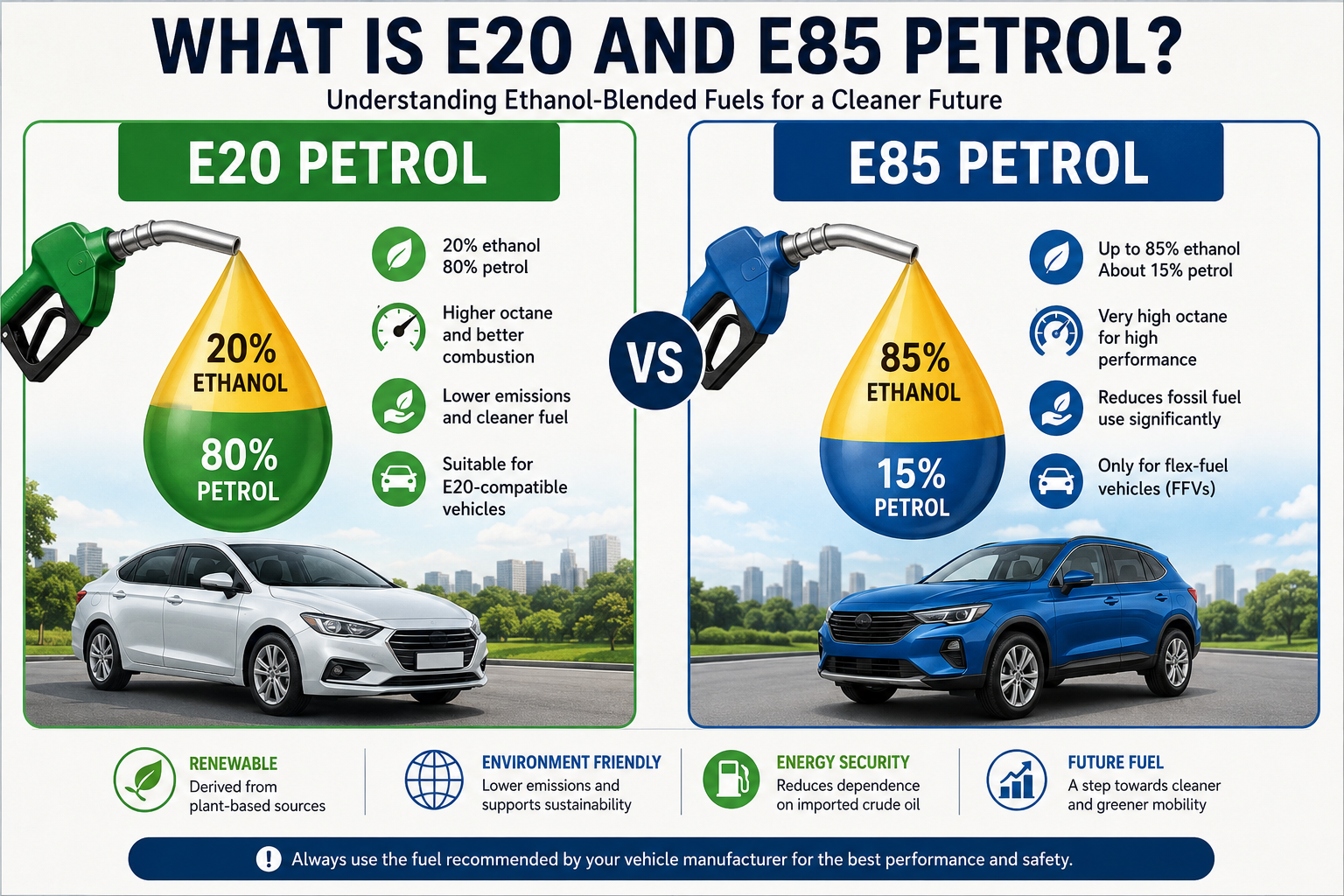
What Is E20 and E85 Petrol
Introduction: What is E20 and E85 petrol
As countries around the world look for cleaner and more sustainable energy sources, ethanol-blended fuels have become an increasingly popular alternative to traditional petrol. Among the most commonly discussed blends are E20 and E85 petrol. While both contain ethanol mixed with gasoline, they differ significantly in composition, performance, compatibility, and environmental impact.
Many drivers have questions such as: What exactly is E20 petrol? How is E85 different? Can any car run on these fuels? Which one is better for the environment and your vehicle? Understanding these differences is important, especially as governments and automobile manufacturers continue to promote cleaner fuel technologies.
This comprehensive guide explains everything you need to know about E20 and E85 petrol, including their composition, benefits, drawbacks, vehicle compatibility, performance characteristics, environmental impact, and future role in transportation.
Table of Contents
What Is Ethanol?
Before understanding E20 and E85, it is important to know what ethanol is.
Ethanol is a renewable alcohol-based fuel produced primarily through the fermentation of crops such as sugarcane, corn, wheat, and other biomass. Unlike fossil fuels that take millions of years to form, ethanol can be produced annually from agricultural resources, making it a renewable energy source.
When blended with petrol, ethanol increases the oxygen content of the fuel, helping engines burn fuel more efficiently and reducing certain harmful emissions. Because of these benefits, many countries have adopted ethanol blending programs to reduce dependence on imported crude oil and encourage sustainable fuel production.
What Is E20 Petrol?
E20 petrol is a fuel blend consisting of:
- 20% ethanol
- 80% conventional petrol (gasoline)
The “E” stands for ethanol, while the number indicates the percentage of ethanol present in the blend.
E20 is designed to provide a balance between environmental benefits and compatibility with modern internal combustion engines. It contains enough ethanol to reduce emissions and fossil fuel consumption while remaining suitable for many newer vehicles that are specifically engineered or approved for E20 use.
Governments in several countries have promoted E20 as part of their strategy to reduce carbon emissions and improve energy security.
Key Characteristics of E20 Petrol
Cleaner combustion
Because ethanol contains oxygen, E20 generally burns more completely than pure petrol, helping reduce certain exhaust emissions.
Renewable fuel source
Part of the fuel comes from renewable agricultural products rather than petroleum, supporting sustainability goals.
Higher octane rating
Ethanol naturally has a higher octane rating than regular gasoline, which can help improve resistance to engine knocking in compatible engines.
Reduced dependence on crude oil
By replacing a portion of petrol with domestically produced ethanol, countries can reduce reliance on imported fossil fuels.
Moderate vehicle compatibility
Many modern vehicles are designed or certified to use E20 safely, but older vehicles may not be compatible without modifications.
What Is E85 Petrol?
E85 is a high-ethanol fuel blend containing up to:
- 85% ethanol
- Approximately 15% petrol
The exact ethanol percentage may vary slightly depending on climate and local regulations, but it remains a fuel with significantly higher ethanol content than E20.
E85 is primarily intended for flex-fuel vehicles (FFVs) that are specially engineered to handle high ethanol concentrations. These vehicles include modified fuel systems, sensors, and engine management software that automatically adjust combustion based on the ethanol content.
Key Characteristics of E85 Petrol
Very high ethanol concentration
E85 contains much more ethanol than E20, making it one of the most renewable fuel blends commonly available.
Excellent octane rating
Its high octane level allows engines specifically designed for E85 to operate efficiently under higher compression conditions.
Reduced gasoline consumption
Because most of the fuel consists of ethanol, E85 significantly lowers reliance on petroleum.
Lower energy density
Ethanol contains less energy per litre than petrol, meaning vehicles running on E85 often consume more fuel to travel the same distance.
Limited compatibility
Only flex-fuel vehicles designed for high ethanol blends should use E85.
E20 vs E85 Petrol: Major Differences
Ethanol content
The biggest difference lies in the percentage of ethanol. E20 contains 20% ethanol, whereas E85 contains up to 85%.
Vehicle compatibility
E20 is intended for vehicles approved for E20 use. E85 requires specially designed flex-fuel vehicles equipped to manage high ethanol levels safely.
Fuel economy
Vehicles using E85 generally experience lower mileage because ethanol provides less energy than petrol. E20 typically causes only a small reduction in fuel economy compared to regular petrol.
Environmental benefits
Both fuels reduce fossil fuel use, but E85 replaces a much larger portion of petroleum with renewable ethanol.
Engine calibration
Flex-fuel vehicles automatically adjust engine settings to accommodate E85, while standard vehicles may not function properly with such a high ethanol concentration.
Comparison Table: E20 vs E85 Petrol
| Feature | E20 Petrol | E85 Petrol |
|---|---|---|
| Ethanol content | 20% | Up to 85% |
| Petrol content | 80% | About 15% |
| Vehicle type | E20-compatible vehicles | Flex-fuel vehicles |
| Fuel economy | Slightly lower than petrol | Noticeably lower than petrol |
| Octane rating | Higher than regular petrol | Very high |
| Renewable content | Moderate | Very high |
| Engine modifications | Usually unnecessary for compatible vehicles | Requires flex-fuel design |
| Environmental impact | Lower emissions | Greater reduction in fossil fuel usage |
How Is Ethanol Produced?
The production of ethanol involves several stages.
First, crops such as sugarcane or corn are harvested and processed to extract sugars or starches. These sugars are fermented using yeast, producing alcohol. The resulting liquid is then distilled and purified to create fuel-grade ethanol.
Finally, ethanol is blended with petrol in controlled proportions such as 10%, 20%, or 85%, depending on fuel standards and intended applications.
Advances in technology are also enabling production from agricultural waste and non-food biomass, which could make ethanol even more sustainable in the future.
Benefits of E20 Petrol
Lower emissions
E20 can reduce certain pollutants released during combustion, contributing to improved air quality.
Supports renewable energy goals
Using ethanol reduces reliance on finite fossil fuel reserves.
Encourages agricultural development
Demand for ethanol can create additional markets for farmers growing feedstocks used in ethanol production.
Better combustion characteristics
The oxygen content in ethanol helps improve fuel combustion in compatible engines.
Helps reduce oil imports
Countries producing ethanol domestically may decrease their dependence on imported petroleum.
Benefits of E85 Petrol
Significant renewable fuel usage
Most of the fuel comes from renewable ethanol sources.
High octane performance
The high octane rating can benefit specially designed engines operating under demanding conditions.
Reduced petroleum consumption
Drivers using E85 consume considerably less gasoline compared to conventional fuels.
Potential greenhouse gas reductions
Depending on feedstock production methods, E85 may contribute to lower lifecycle greenhouse gas emissions.
Potential Drawbacks of E20 Petrol
Although E20 offers many benefits, there are some considerations.
Older vehicles not designed for E20 may experience compatibility issues involving fuel lines, seals, or engine components.
Some drivers may notice a slight reduction in fuel economy because ethanol contains less energy than pure petrol.
Fuel availability may also vary depending on location and infrastructure development.
Potential Drawbacks of E85 Petrol
E85 also presents certain challenges.
Because ethanol has lower energy density, vehicles generally require more fuel to cover the same distance.
Availability remains limited in many regions, reducing convenience for drivers.
Using E85 in vehicles not designed for it can lead to poor performance or mechanical damage.
Additionally, some flex-fuel vehicles may experience reduced driving range between refueling stops due to increased fuel consumption.
Can Regular Cars Use E20?
Many modern vehicles are engineered or certified to operate safely on E20, but compatibility depends on manufacturer recommendations.
Drivers should always consult the owner’s manual or manufacturer guidance before switching fuels. Using an approved fuel ensures optimal engine performance and long-term reliability.
Older vehicles may require modifications or may not be suitable for E20 at all.
Can Regular Cars Use E85?
Generally, no.
E85 should only be used in flex-fuel vehicles specifically designed to accommodate high ethanol concentrations. These vehicles include specialized fuel system components and electronic controls that adapt to varying ethanol levels.
Using E85 in a conventional petrol vehicle can result in hard starting, improper combustion, fuel system damage, warning lights, or long-term mechanical issues.
Performance Differences Between E20 and E85
Performance depends heavily on engine design.
E20 usually provides performance similar to conventional petrol with only modest differences in fuel economy.
E85, however, often requires greater fuel consumption because of its lower energy content. Nevertheless, engines optimized for E85 can take advantage of its high octane rating to produce impressive power under certain conditions.
For ordinary drivers using standard vehicles, manufacturer-approved fuel remains the best choice.
Environmental Impact of E20 and E85
Both E20 and E85 contribute toward reducing fossil fuel dependence.
Because ethanol is derived from renewable biological sources, replacing part of conventional petrol with ethanol can lower net carbon emissions over the fuel’s lifecycle. The extent of these benefits depends on farming practices, production efficiency, transportation, and land use.
E85 generally offers greater renewable content than E20, but its overall environmental advantage depends on responsible ethanol production and distribution.
Economic Importance of Ethanol Blending
Beyond environmental benefits, ethanol blending has economic significance.
Countries that produce ethanol domestically can reduce fuel import bills and improve energy security. Farmers gain additional demand for crops used in ethanol production, supporting rural economies.
Investment in biofuel industries can also create employment opportunities across agriculture, manufacturing, transportation, and fuel distribution sectors.
Safety Considerations
Drivers should always use the fuel recommended by their vehicle manufacturer.
Mixing incompatible fuels or using E85 in non-flex-fuel vehicles can result in operational problems and expensive repairs.
Proper storage is also important, as ethanol can absorb moisture more readily than conventional petrol under certain conditions.
Fuel stations clearly label ethanol blends, allowing consumers to make informed choices before refueling.
The Future of E20 and E85
As governments pursue cleaner transportation strategies, ethanol blends are expected to remain an important transitional fuel.
Automobile manufacturers continue developing engines capable of using higher ethanol blends efficiently, while biofuel technologies are improving sustainability and production methods.
At the same time, electric vehicles and other alternative energy sources are expanding rapidly. Nevertheless, ethanol-blended fuels may continue to play a significant role, especially in regions where conventional internal combustion engines remain widespread.
Future advancements in second-generation ethanol made from agricultural waste and non-food biomass could further enhance the environmental benefits of these fuels.
Which Fuel Should You Choose?
The answer depends entirely on your vehicle.
If your manufacturer approves E20, it can be a practical option that supports renewable energy goals while maintaining familiar driving characteristics.
If you own a flex-fuel vehicle specifically designed for E85, using E85 may help reduce gasoline consumption and increase renewable fuel usage.
Drivers should never choose a fuel solely because it contains more ethanol. The safest and most effective approach is always to follow the manufacturer’s recommended fuel specifications.
Conclusion
E20 and E85 petrol are both ethanol-blended fuels designed to reduce reliance on conventional gasoline and promote cleaner transportation. E20 contains 20% ethanol and is suitable for many modern vehicles that are approved for its use, while E85 contains up to 85% ethanol and is intended specifically for flex-fuel vehicles.
Although both fuels contribute to renewable energy objectives and may help lower certain emissions, they differ substantially in vehicle compatibility, fuel economy, and intended applications. Understanding these differences is essential for protecting engine health and achieving optimal performance.
As biofuel technologies continue to evolve, ethanol blends such as E20 and E85 are likely to remain valuable components of the global transition toward more sustainable transportation.
FAQs
1. What does E20 mean in petrol?
E20 refers to a fuel blend made up of 20% ethanol and 80% conventional petrol.
2. What is E85 petrol used for?
E85 is primarily designed for flex-fuel vehicles that are engineered to operate safely on high concentrations of ethanol.
3. Can I use E85 in a normal petrol car?
No. Unless the vehicle is specifically approved as a flex-fuel model, using E85 may lead to performance problems or mechanical damage.
4. Is E20 better for the environment?
E20 can reduce reliance on fossil fuels and may lower certain emissions by incorporating renewable ethanol into the fuel supply.
5. Does E85 provide better mileage than petrol?
Generally, no. Because ethanol contains less energy per litre than petrol, vehicles running on E85 often achieve lower fuel economy.
6. How can I know if my car supports E20 or E85?
Check your owner’s manual, fuel filler label, or consult the vehicle manufacturer. Following the recommended fuel specification is the best way to ensure safe operation and long-term reliability.
About the Author